The Temple of Heaven is easier to understand as a carefully arranged set of ritual spaces than as one blue-roofed building. The walk below reads the differences between praying for harvests, storing sacred tablets and sacrificing beneath the open sky. It is an original editorial route based on park and heritage sources checked on 7 November 2026, with no ticket account or step-free circuit personally tested.
Before you start
- Choose a day when the architectural areas you want are open.
- Confirm whether the order is park admission, a combined ticket or a separate attraction component.
- Carry the original booking passport and any issued QR confirmation.
- Save the entrance, intended exit and a shorter route for weather or fatigue.
Buy access to the places you actually want to see
The March 2026 parks-administration answer defines the combined ticket as general park admission plus the Hall of Prayer for Good Harvests, Echo Wall and Circular Mound areas. A basic park ticket does not become that combined product because it features the same building photograph.
The municipal visitor guide documents passport booking through the park's official ticketing account. Use the official 天坛 channel or the parks platform it links, choose your actual document and check the issued order. If the form cannot process it, ask the park's service on 010-67028866 about the supported route; a failed form is not an exemption from a required ticket.
If online purchase is unavailable, the Parks Centre's published alternative is staff-assisted purchase at a comprehensive service window in the park's gate area with a valid identity document. Bring your original passport, ask for the park or combined product you need, and confirm current selling arrangements. This does not guarantee availability or access to a closed architectural compound; do not assume every gate offers the same service.
Park access and architectural-area access have different hours. The September 2026 notice confirms resumed Monday closures for the historic building complexes, except statutory holidays. An open gate early in the morning or evening does not mean the hall is admitting visitors. Verify the specific date and final entry before travel.
Read two ritual centres instead of one attraction
UNESCO's heritage description explains an axial arrangement of the northern Hall of Prayer, a raised way and the southern altar complex. The emperor's role in mediating between earthly society and heaven was expressed through organised space, ceremony and landscape.
Use that as an interpretive framework rather than treating every visual feature as a mysterious code. Ask where a participant would approach, where people could gather and how a building changes the relationship between the body and the sky. The park's quiet distances are part of this reading, not just empty ground between photographs.
This was an imperial ritual setting, not simply another palace residence or an interchangeable Buddhist temple. Distinguish historical ritual interpretation from present-day access: you can learn from the layout without claiming that a visitor is witnessing an original ceremony.
Start with the east-side approach and the Hall of Prayer
Tiantandongmen 天坛东门 on Metro Line 5 is one useful arrival named by the official visitor guide; Tianqiao 天桥 on Line 8 suits another side of the park. Choose the entrance that matches your order and walking plan. This route starts on the east side, then heads towards the northern architectural centre rather than immediately crossing the whole site.
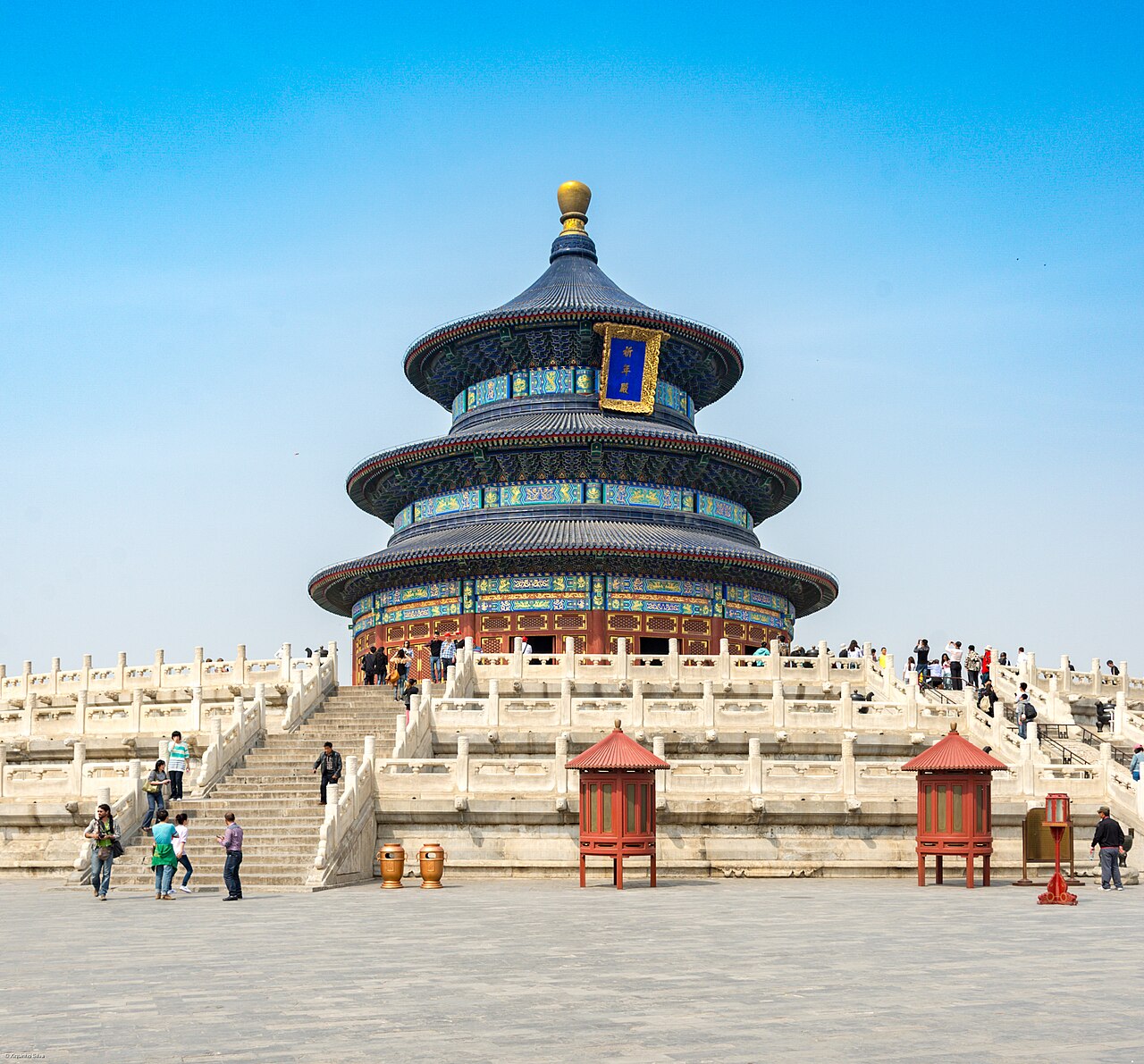
At the Hall of Prayer for Good Harvests 祈年殿, look at the roof's repeated rising tiers, the platform and the open space around it. The park explains that the site began with a differently shaped hall and changed over successive rebuildings; the unified blue roof belongs to a later stage of that history.
The hall served the early-year prayer for grain harvests. That function connects its impressive form with an agricultural concern, rather than reducing it to imperial decoration. Read the on-site interpretation and compare the exterior with the viewing position staff permit. Do not assume admission lets you walk freely inside every building.
Walk the Danbi route as a transition
Continue south along the permitted path near Danbi Bridge 丹陛桥. The park describes it as a raised ceremonial way linking the northern prayer area with the southern altar area, rising towards the north. Its bridge name relates to a passage beneath it, not a river crossing you should expect to find.
Pause where you can step out of the pedestrian flow and look both ways. Notice how the long alignment makes one ritual centre visible in relation to the other. This walking exercise is more useful than racing across it to tick off another structure. Keep to current marked routes rather than interpreting a historical processional privilege as an instruction for visitors today.
Separate the Imperial Vault from the famous northern hall
The Imperial Vault of Heaven 皇穹宇 is a different building from the Hall of Prayer. The park identifies it as the place where the deity and ancestral tablets used in the Circular Mound ceremonies were housed. Compare its smaller scale and roof profile with the northern hall.
The surrounding Echo Wall 回音壁 is part of this courtyard. Treat its acoustic reputation as an invitation to understand the shape and enclosure, not to shout across other visitors or touch the historic surface. Crowds, barriers and background sound can limit any demonstration; an unsuccessful echo does not make the architectural visit a failure.
Read the supporting spaces too, where open. Storage, preparation and controlled movement make ritual possible, even when the central building receives most photographs. Do not add a separately ticketed or closed area on the assumption that a combo includes every institution inside the outer park.
End the architectural sequence beneath the sky
The Circular Mound 圜丘 was used for winter-solstice sacrifice to heaven. It is an open altar rather than another roofed hall. The park describes carefully ordered circles and numerical relationships in its stones, steps and balustrades.
Look from an allowed position at how an open sky changes the experience after enclosed courtyards. Notice the repeated levels without needing to count every stone. If steps are unsuitable, ask staff which lower viewing position is feasible; a complete climb is not required to grasp the difference in form.
After this southern group, leave through the gate that fits your actual energy and onward route. A south-side finish avoids walking back simply to reproduce the entrance journey. Check the current map and lawful pickup point rather than assuming every park gate opens onto an app-car stopping area.
Leave room for the park without confusing it with the ticketed halls
The wider grounds offer a different pace. Keep a short tree-lined walk or seated break, especially after a crowded building area. If you encounter singing, games or exercise, observe without blocking the group and ask before a close portrait. Participation is by invitation, not something a ticket entitles a visitor to demand.
A Monday park walk can still have value when the buildings are closed, provided that is the experience you chose. It cannot substitute for promised access to the main architectural compounds. For an architecture-first trip, move the visit to a verified opening day.
Shorten the route before discomfort decides it for you
Large paved spaces can be exposed to heat and wind. Wet stone and winter ice change footing; use suitable shoes, water and layers. Keep architectural-area closing separate from the park's later closing when deciding whether to continue.
For reduced mobility, ask about your exact entrance, thresholds, ramps, toilets and rest points. This guide does not certify a continuous step-free axis. A shorter northern-hall visit, if its approach is suitable and open, may work better than a full circuit. Choose a meal or another confirmed indoor stop afterwards rather than adding the Palace Museum as a rushed second monumental visit.
Common questions
Does a park ticket include the Hall of Prayer?
Check the product. The official combined ticket includes the named architectural areas; basic park admission alone is different.
Can I visit the buildings on Monday?
They normally close on Mondays, with statutory-holiday exceptions and current notices controlling the exact date.
Is the Imperial Vault the same as the Hall of Prayer?
No. They occupy different parts of the ritual axis and served different functions.
Can I see the main hall late at night because the park is open?
Do not assume that. Building areas have their own entry hours, and evening exterior lighting does not mean interior admission.
Sources & checking notes
- Beijing Municipal Administration Center of Parks: combined-ticket scope, March 24, 2026
- Beijing municipal visitor guide: passport channel, transport and separate access periods
- Beijing municipal notice: architectural complexes resume Monday closures, September 2026
- Temple of Heaven Park: Hall of Prayer history and function
- Temple of Heaven Park: Danbi Bridge and ceremonial way
- Temple of Heaven Park: Imperial Vault function
- Temple of Heaven Park: Circular Mound ritual and design
- UNESCO: Temple of Heaven layout and imperial ritual significance
- Beijing Parks Centre: assisted on-site park ticket purchase with valid documents, 22 July 2025
Sources checked on 7 November 2026. Workflows, routes and troubleshooting suggestions are editorial guidance. Fees, eligibility, reservations and local services can change; follow the official links before relying on a rule.
Original synthesis of public information and editorial planning advice. We have not performed a live account, payment or on-site test of every workflow. This guide does not claim a firsthand visit or professional accreditation.