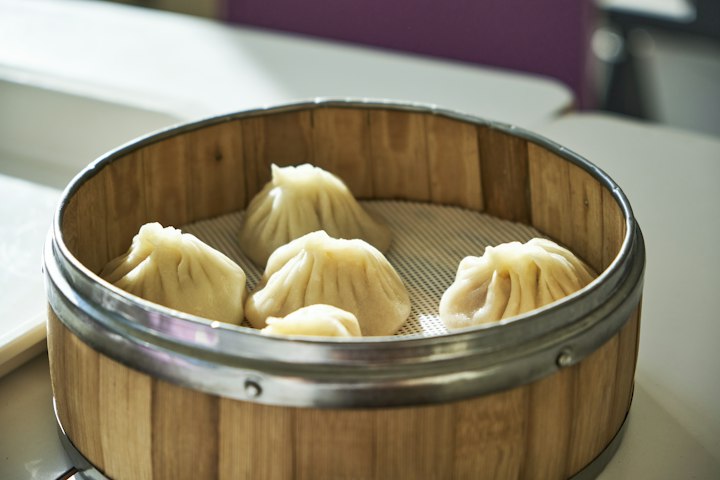
Shanghai’s snack menus can turn a simple lunch into a complicated project: several dumplings with similar English names, branches on opposite sides of the city, and a queue that may consume the time you meant to spend in a garden. Begin with two decisions: steamed or pan-fried, and a convenient central stop or a dedicated neighbourhood outing. You can learn more from comparing a few carefully chosen foods than from attempting every celebrated shop in one day.
Recognise the names before joining a queue
Xiaolongbao, 小笼包, xiǎolóngbāo, are the steamed soup dumplings commonly associated with Shanghai. Shengjian, 生煎, shēngjiān, are pan-fried buns. Menus may say 生煎馒头, shēngjiān mántou: do not interpret the last word as a promise of a plain, unfilled bun. Shanghai’s municipal food introduction explains this local naming usage.
Compare the actual product photographs, written filling and cooking description. English dumpling and bun translations are not consistent enough to identify texture or ingredients by themselves. Also distinguish an ordinary basket from a large soup-filled item or a tasting set. Ask for the number of pieces, not simply the smallest-looking price on a board.
Choose xiaolongbao by filling and location
The city’s March 2026 introduction describes a thin wrapper holding filling and broth produced as jelly melts during steaming. Pork and crab-containing versions feature in its examples. A seafood-sounding product can also contain pork; a vegetable-sounding filling does not establish a vegetarian broth or preparation.
Nanxiang is a place in Jiading district, while the familiar Nanxiang Steam Bun Restaurant in Yuyuan Garden Malls is a central restaurant destination. Do not navigate to the town when you intended to eat near Yu Garden, or assume that every map result with Nanxiang in its name is the same branch.
For a short first visit, choose the branch that fits your booked sightseeing. A dedicated trip to Nanxiang can be worthwhile if the town itself interests you; it is a different outing from adding lunch to the old-city area. Compare the complete journey and current opening information before committing. A famous name alone is not a reason to cross Shanghai twice.
Compare shengjian textures rather than chasing the most soup
The municipal shengjian feature distinguishes hunshui, 浑水, húnshuǐ, with added aspic and semi-leavened dough, from qingshui, 清水, qīngshuǐ, using fully leavened dough without added aspic. It identifies Da Hu Chun as an example of the latter. The practical consequence is that a less soupy bun is not automatically a failed version.
Ask what the shop makes if texture matters to you. A breadier bun with a crisp base and a thinner, broth-rich one provide different experiences. Compare one modest order of each across separate meals rather than ordering several full portions at once. Availability and recipes remain branch-specific.
Check whether the quoted unit means pieces, a portion or a traditional ordering measure. You may see liang, 两, liǎng, used for an order, but let staff confirm how many buns you will receive. The dish is filling enough that an apparently small plate can change your plans for the next restaurant.
Give hot broth time and use the available utensils
Treat a newly served soup dumpling or juicy pan-fried bun as very hot. Move it carefully onto a spoon or small plate, let it cool, and open the wrapper cautiously. Take time before drinking any liquid inside. This is practical eating advice, not a performance with a correct number of motions.
Ask for a spoon if one is missing: 可以给我一个勺子吗? Kěyǐ gěi wǒ yí ge sháozi ma? — Could I have a spoon? If chopsticks are unfamiliar, request suitable utensils rather than rushing. Let children’s portions cool and help them avoid squeezing a filled bun toward another person.
Try a small amount before adding vinegar or ginger. Condiments are optional choices; you need not imitate a neighbouring diner exactly. Ask for a clean shared serving utensil where useful, and keep each diner’s dietary requirements clear when several baskets arrive together.
Use the Nanjing Road area for a compact comparison
A February 2026 Huangpu district feature, published by the municipality, describes a cluster of established food businesses around South Shanxi Road, Middle Fujian Road and Middle Jiangxi Road near Nanjing Road. Its examples include shengjian, Shanghai-style dishes, pork with rice cake, pastries and other regional or Western-influenced food. The area therefore supports more than an all-dumpling itinerary.
Use that historical feature as an area lead, then confirm the current branch on a live map or with the business. The reopening promotions mentioned in it have ended. Do not rely on old launch-period offers, addresses of former premises, or a cached listing to promise that a particular counter is operating today.
Choose one seated meal and one takeaway or pastry stop. If the first place has a queue longer than your available break, inspect another nearby option rather than losing the afternoon to a sunk decision. A short menu and a visible price can make an unfamiliar shop easier to use than an exhaustive list of must-try names.
Balance buns with a different kind of dish
After a steamer or pan-fried buns, consider whether you actually want more dough. A soup, a small shared dish or a later pastry may provide a more varied day. Ask what a noodle or wonton soup contains rather than assuming the clear liquid is meat-free. Broth, filling, garnish and frying fat are separate ingredient questions.
The Nanjing Road-area feature identifies Xian De Lai with pork and rice cake and Sanyang with goods including cakes and pastries. These are examples for research, not universal recommendations for every diet. Check the current product and serving style at your chosen location. Packaged food also deserves an ingredient check; an attractive gift box is not an English allergen declaration.
For a mixed group, make lunch a place with enough verified alternatives, then let interested diners add a small specialist snack. This works better than expecting someone with a strict restriction to subsist on an unspecified side dish while everyone else follows a dumpling circuit.
Finish with a clear order and a realistic schedule
这是什么馅的? Zhè shì shénme xiàn de? — What is the filling? 一份几个? Yí fèn jǐ ge? — How many pieces in one order? 我们想先点一份。 Wǒmen xiǎng xiān diǎn yí fèn. — We would like to order one portion first. Point to the exact menu line when using these phrases.
Read the bill for tea, additional dishes and takeaway packaging. If paying electronically, check the recipient and order result before leaving. Allow a buffer before timed attraction entry, and avoid carrying a hot open food container through crowded passages. A successful snack day ends with enough appetite and time to enjoy the rest of Shanghai.
Common questions
Are all Shanghai shengjian full of soup?
No. Official local food guidance describes different dough and filling styles, including a fully leavened version without added aspic. Ask about the shop’s preparation rather than judging every bun against one model.
Should I go to Nanxiang town for xiaolongbao?
Choose it when the town is part of the outing you want. For a central sightseeing day, a verified city branch can be more practical. Check the actual address before travelling.
Are crab xiaolongbao pork-free?
Do not assume so. Ask about the complete filling, aspic and preparation. A crab label can describe an additional ingredient rather than an exclusive one.
Sources & checking notes
- Shanghai municipal government — Xiaolongbao, March 2026
- Shanghai culture and tourism / Huangpu district — Pan-fried pork buns, April 2026
- Huangpu district / Shanghai municipal government — Food-brand cluster near Nanjing Road, February 2026
Sources checked on 7 November 2026. Workflows, routes and troubleshooting suggestions are editorial guidance. Fees, eligibility, reservations and local services can change; follow the official links before relying on a rule.
Original synthesis of public information and editorial planning advice. We have not performed a live account, payment or on-site test of every workflow. This guide does not claim a firsthand visit or professional accreditation.