You do not need to decode every character to make a good order. A more useful goal is to identify the main ingredient, preparation, portion and price, then ask about anything important that remains unclear. A menu is an invitation to a conversation, not a complete recipe or a guarantee about a kitchen.
Read in layers instead of translating every word
First establish the type of menu: individual bowls, shared plates, a set meal or a display of separately priced items. Look for the price beside the specific item and check whether the photograph represents the standard serving. A picture may show a combination whose components are ordered separately.
Next look for an ingredient and a preparation word. Oxford's Chinese-language teaching resource uses this approach, explaining how a name such as 炒肉片 combines a cooking action, meat and a sliced form. This is a useful pattern rather than a rule for every poetic or regional dish name. Oxford menu-reading resource
Keep unknown words visible. You may recognise chicken and a cooking method while missing an organ, sauce or garnish. Rather than silently filling the gap, point to the complete name and ask staff what the dish contains. That makes the answer specific to the version you will receive.
Build a small ingredient vocabulary
Useful starting words include 猪肉 zhūròu, pork; 牛肉 niúròu, beef; 鸡肉 jīròu, chicken; 羊肉 yángròu, lamb or mutton; 鱼 yú, fish; 虾 xiā, shrimp; 豆腐 dòufu, tofu; and 鸡蛋 jīdàn, egg. Learn the words relevant to your own tastes first rather than memorising a long list you will not use.
Also notice the supporting vocabulary: 汤 tāng for soup, 酱 jiàng for sauce or paste, 油 yóu for oil, and 馅 xiàn for filling. None of these words tells you the complete composition. A recognisable main ingredient can sit inside a more complex broth, dressing or mixture.
A food name can also refer to a style, appearance or cultural association. Do not assume that a literal translation lists the ingredients. A word suggesting vegetables does not establish that a dish excludes animal stock, and an English label may simplify several Chinese terms.
Use cooking words to predict the format
Several useful preparation words are 蒸 zhēng, steam; 煮 zhǔ, boil; 炒 chǎo, stir-fry; 煎 jiān, pan-fry; 炸 zhá, deep-fry; and 烤 kǎo, roast or bake. Learn them as clues to texture and presentation, then confirm the particular dish. The same broad English cooking word can cover more than one Chinese technique.
An academic study of translated Chinese menus found inconsistent treatment of ingredients and methods and the loss of some cultural associations. Its practical lesson for a traveller is modest: a short English label may not communicate every distinction in the original name. Use it as one clue alongside the Chinese and staff explanation. University of Stirling research manuscript
Do not assume that a simple-sounding method produces a plain dish. Ask about seasoning, sauces and accompaniments. If the preparation is already complete, a request to remove one element may not be possible; another menu item may be the clearer choice.
Settle the serving and price before ordering
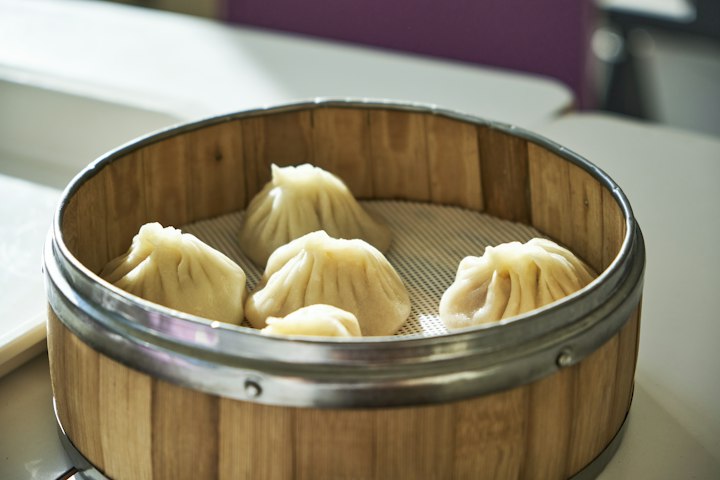
Ask whether an item is priced per piece, portion, bowl or weight. 个 ge, 份 fèn and 碗 wǎn are useful quantity words to recognise, but the actual portion size still needs checking. A basket or plate in a photograph does not reliably tell you how much food one order buys.
Try 这一份有多少?— Zhè yí fèn yǒu duōshao? — 'How much is in one portion?' For a priced weight or a seasonal item, ask staff to explain the quantity and total before it is prepared. Check whether rice, drinks or optional additions need separate orders.
When eating with companions, choose a workable balance of shared dishes and individual staples rather than copying an arbitrary dishes-per-person formula. State your group size and ask about portions. It is easier to add an item than to discover that several photographed platters were all large.
Use the phone to focus a question
Photograph or scan the relevant part of the menu where permitted and keep the original visible beside the translation. Check that the app has captured the right line, not a price, heading or neighbouring dish. A blurred character can change the result while still producing plausible English.
Use the translation to identify the word you need to ask about. Pointing to one complete dish and asking 'What is the filling?' or 'What is in the sauce?' is often more manageable than showing staff a screen full of uncertain machine output. Ask for a simpler description if a historical or metaphorical name remains unclear.
Confirm the final order before payment or preparation: item, quantity, important request and total. For a digital menu, check the basket before submitting and save the order record. This guide does not claim to have tested a particular app or a restaurant's interface.
Separate preferences from restrictions
For a preference, ask whether an ingredient can be reduced or omitted. For an allergy or religious requirement, explain the specific issue and ask about the full preparation. A request for less chilli is different from a need to avoid an ingredient completely.
FARE's chef-card resource offers Chinese templates while noting translation nuances. A reviewed card can help communicate an allergy to the kitchen; reading a menu or showing a translated label does not certify the meal. Use the dedicated dietary guide for that fuller conversation. FARE chef cards
Keep a short personal vocabulary note after a successful order: Chinese name, what it was, portion and what you would ask next time. The aim is growing confidence through specific observations. Leave room for another shop to prepare a similarly named dish differently.
Common questions
Can I treat an English menu as a complete ingredient list?
No. It may simplify a dish name or omit supporting components. Ask about the actual ingredients and preparation when those details matter.
Does recognising a vegetable or tofu name establish a vegetarian dish?
No. Confirm broth, fat, sauces and other components, and explain your specific requirements before ordering.
Should I translate the entire menu?
Start with the section and a few dishes you might choose. Confirm their ingredients, portions and prices rather than trying to resolve every unfamiliar word at once.
Sources & checking notes
- Oxford Centre for Teaching Chinese as a Foreign Language: reading a menu
- University of Stirling repository: A Corpus-Based Multimodal Approach to the Translation of Restaurant Menus
- FARE: food allergy chef cards and translation guidance
Sources checked on 7 November 2026. Workflows, routes and troubleshooting suggestions are editorial guidance. Fees, eligibility, reservations and local services can change; follow the official links before relying on a rule.
Original synthesis of public information and editorial planning advice. We have not performed a live account, payment or on-site test of every workflow. This guide does not claim a firsthand visit or professional accreditation.