A classical garden can be small on a map and expansive in experience. The interest lies in how a path, wall, opening or reflection changes the scene as you move. Suzhou offers a useful starting point, but the aim is not to finish a list of gardens: it is to learn how to look closely enough that one visit becomes memorable.
Understand what the Suzhou example represents
UNESCO's Classical Gardens of Suzhou property brings together nine gardens and explains their combination of nature, residence, artistic craft and literary meaning. Its interpretation describes landscapes created within limited spaces using rocks, water, plants and buildings. That is a starting context, not a claim that every Chinese garden has the same scale or history. UNESCO Suzhou interpretation
Read the actual garden's introduction before entering. Who commissioned it, how did it change, and what part survives or has been restored? A place's founding date is not automatically the date of every building or planting you see. Keeping those layers separate makes the visit richer rather than less impressive.
Choose one garden for a close first visit. Later, a second can become a comparison of layout, scale and atmosphere. Visiting several in quick succession can leave you remembering only doorways and crowds instead of the relationships that make each space distinctive.
Follow a path, then look back
At the entrance, notice what is immediately visible and what the route withholds. Walk a short distance, pause safely out of the flow, and look back. Does the same opening now frame a different scene? Does a wall hide a part you could hear before you could see it?
Try treating a corridor as part of the garden rather than only a way to reach the next attraction. Observe the changes between enclosure and openness, shade and brightness, or a narrow approach and a broader view. You can notice these effects without knowing a technical name for every structure.
The Metropolitan Museum's educational account of its Astor Court, modelled on a Suzhou scholar's courtyard, encourages attention to movement through a deliberately composed landscape. Its New York example is a learning aid, not another stop on a Suzhou itinerary. Met garden-court resource
Look for relationships rather than isolated ornaments
Choose a view containing more than one element. How does a rock formation meet water, planting or a building? Is the rock meant to be viewed from one position, encountered along a route or seen again across a pond? Avoid assuming every prominent stone is intended for climbing.
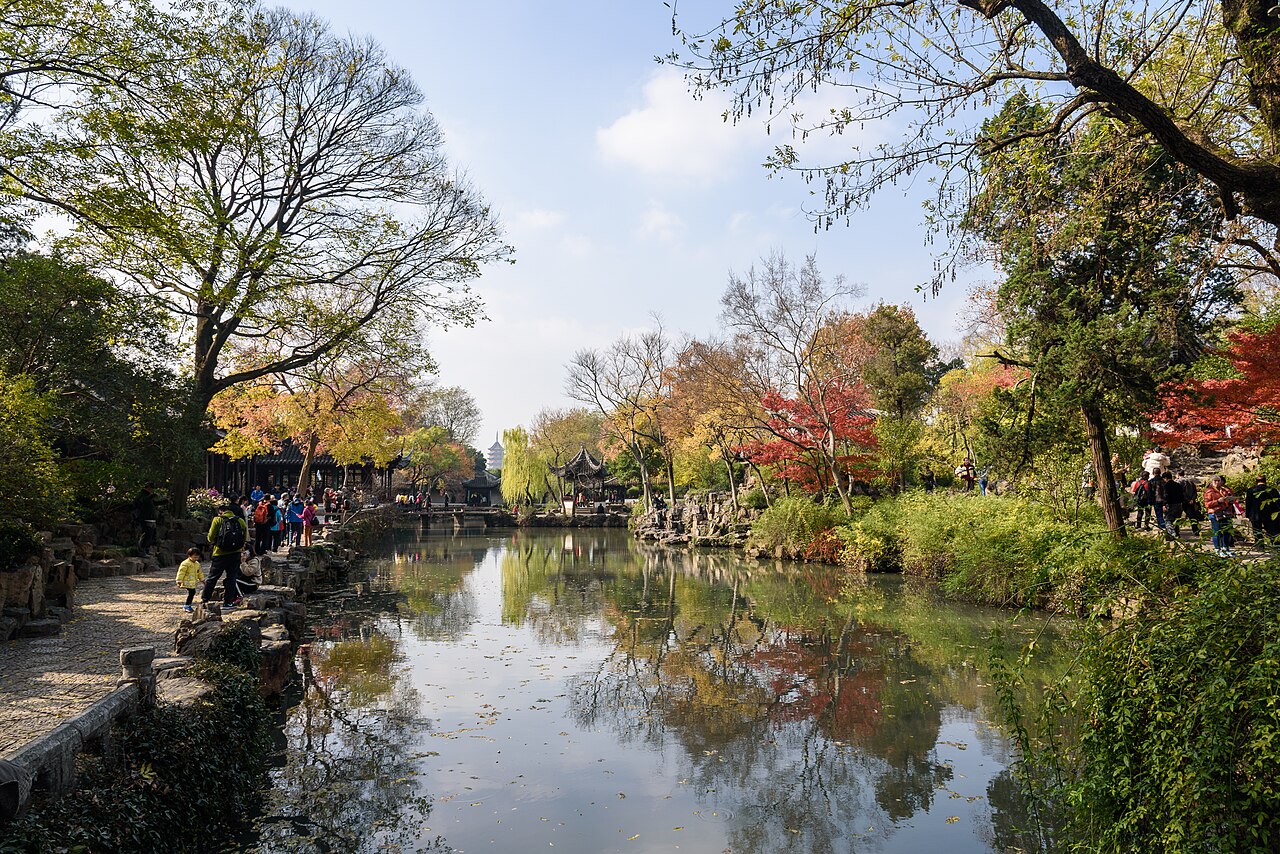
Notice reflection as part of the composition when conditions allow. Water can repeat a roofline or make an opening seem deeper, while a change in viewpoint alters what overlaps. You do not need a perfect reflection for the visit to work; the available light and weather create their own version of the scene.
The Met's interpretation connects compact rock and water arrangements with the suggestion of larger landscapes. Use that idea to investigate scale: a small composition can invite a large mental journey. Keep your own description separate from any symbolism a guide specifically attributes to the garden.
Give buildings, inscriptions and furnishings time
A pavilion or room is not merely background for a photograph. Ask what it faces and how the view changes from its edge, doorway or permitted interior. Look at the relationship between a place to sit and the scene beyond. Follow barriers and avoid occupying a seat or passage so long that others cannot use it.
Read a few names, plaques or couplets through an authorised guide or the garden's interpretation. A translation can introduce a literary association without making you an expert in the original poem. Choose one that connects to a visible feature and ask why the name is used here.
Compare the near and far parts of the view. A screen, window, roof or outside tree may participate in the composition. This is a useful observation prompt, but a visually pleasing background does not prove that every modern surrounding feature was intended by the historical designer.
Use the map to select a real visit
UNESCO's component map identifies the individual gardens within the serial property. They are separate places, not one attraction entered through a single gate. Use their names to research the operator, location and access arrangements for the garden you actually choose. UNESCO component map
Connect the visit with the Suzhou city guide and the Shanghai–Suzhou–Hangzhou route only after checking the day's transport and bookings. A garden can be a focused part of a Suzhou stay rather than a hurried detour between intercity trains. Leave room for the surrounding neighbourhood, a meal and the return journey.
For mobility or sensory requirements, ask about the complete visitor route: entrance, thresholds, surfaces, corridors, toilets and exit. A compact site can still contain obstacles. A different entrance or a shorter route is useful only if it connects the areas you need; no physical access audit is claimed here.
Leave with three specific observations
Give yourself a small looking plan: one changing view, one relationship between materials, and one name or historical fact. Take a photograph where permitted or write a short note. You are more likely to remember these than an undifferentiated sequence of garden images.
If you visit a second garden, ask the same questions and compare the answers. Which route felt more enclosed? Where did the design invite you to pause? How did the buildings participate? These are personal observations, not a ranking of which place is most authentic.
Recheck current opening, reservations and any temporary route restrictions through the actual operator. Weather and visitor flow affect the experience, but no particular hour guarantees solitude. Use quieter moments when they occur and allow other visitors to enjoy the same carefully limited spaces.
Common questions
Are all nine UNESCO Suzhou gardens one attraction?
No. They are separate components of a serial property. Choose the actual garden, then verify its own location, booking and visitor arrangements.
How many gardens should I visit on a first trip?
Begin with one you can explore without rushing. Add another for a deliberate comparison if your time, interest and route allow.
Does a small garden mean easy physical access?
No. Ask about thresholds, steps, surfaces, toilets and the full route. Scale alone does not establish accessibility.
Sources & checking notes
- UNESCO: Classical Gardens of Suzhou
- Metropolitan Museum of Art: The Astor Chinese Garden Court
- UNESCO: Suzhou property components and maps
Sources checked on 7 November 2026. Workflows, routes and troubleshooting suggestions are editorial guidance. Fees, eligibility, reservations and local services can change; follow the official links before relying on a rule.
Original synthesis of public information and editorial planning advice. We have not performed a live account, payment or on-site test of every workflow. This guide does not claim a firsthand visit or professional accreditation.